
Ayodhya: History, Faith, Ram Mandir and Modern Development
Introduction
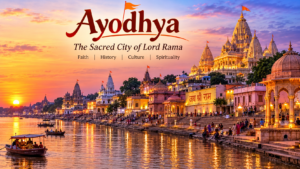
Ayodhya is one of the most famous cities in India, considered a religious and historic place. It is located on the banks of the River Sarayu. Most Hindus believe that this city is the birthplace of Lord Rama, the central figure in the epic poem Ramayana. For them, Ayodhya is a symbol of faith, idealism, and devotion to God.
However, Ayodhya is not just a religious destination. It has a wide range of topics concerning its history, ancient temples, cultural diversity, political and legal issues, and modern development. Today, Ayodhya has become one of the major pilgrimage and tourist centers in India.
Ancient History and Religious Importance
The region of Ayodhya is prominently featured in the ancient epic the Ramayana. According to Hindu tradition, Ayodhya is the kingdom of King Dasharatha, the birthplace of Lord Rama, an incarnation of Vishnu, and a perfect king who personified truth and righteousness.
The archaeological site of Ayodhya had a long and complex history long before Rama was born. Ancient Indian epics, historical records, excavated artifacts, and inscriptions provide valuable insights into the region’s early history. At the same time, it is essential to remember that different sources say different things, and religious traditions should not be confused with historical facts.
Ayodhya is also known as Saketa, an ancient city that was once the center of Hindu, Buddhist, and Jain cultures. This region has a vast cultural and historical significance and attracts both religious pilgrims and scholars who study ancient India.
Spiritual Experience of Ayodhya
For the visitor, Ayodhya is a land of temples, ringing bells, music, rituals, and holidays. The most famous of all is the holy river Sarayu.
Pilgrims come to Ayodhya to perform a variety of rituals and prayers on the banks of the river. They also bring a host of offerings from their homes on the occasion of the evening bath. During the Diwali and Ram Navami holidays, the city is especially festive, as a large number of pilgrims arrive in the city.
There is no shortage of places in Ayodhya associated with Rama, Sita, and Hanuman. This city is so closely related to Indian mythology that it seems to be inseparable from it.
The Ram Janmabhoomi Dispute
“The Ram Janmabhoomi Dispute” is one of the most famous events in the modern history of Ayodhya.
It was believed to be the birthplace of Lord Rama. But, a mosque called the Babri Masjid was built on the supposed site. The mosque was demolished on 6 th December 1992.
The dispute over the site was one of the most sensitive issues in modern Indian history.
The issue was brought before the Supreme Court which studied the ancient manuscripts and concluded the disputed structure was a temple, based on evidence of worship and possession, and directed the disputed site to be allocated for the construction of a temple and that a five-acre alternative land be given for the construction of a mosque. It further observed that the demolition of the Babri Masjid was an act of “unlawful, non-justiciable act”.
It is important to distinguish between religious, historical and legal dimensions of this dispute.

The Ram Mandir
The construction of the Ram Mandir started after the judgment of the Supreme Court at the site of the Ram Janmabhoomi. For millions of Hindus, this is a great religious and cultural achievement.
The temples have been built using traditional architectural designs but also include modern structures on a huge scale to meet the needs of millions of pilgrims.
At the same time, for the devotees, it is not just an architectural masterpiece that embodies the ideal of Hinduism and reconnects them with Lord Rama. In addition, this place is sacred, as it is the burial ground (tomb) of Lord Rama and an important center of Ayodhya. Consequently, the temple is of great historical and religious importance to Hindus.
Important Places in Ayodhya
The Ram Janmabhoomi is the most popular pilgrimage place in the city, as it is considered to be the birthplace of Lord Rama.
The Hanuman Garhi is a significant temple complex in Ayodhya, where Lord Hanuman is the main deity.
The Kanak Bhawan is connected to Rama and Sita and is famous for its devotion and traditional architecture.
The banks of the Sarayu river and its ghats are also worth visiting as you can witness different Hindu rituals, watch evening gatherings and ceremonies. People are going to see various cultural traditions in this territory.
There are many more ancient places and small temples in Ayodhya.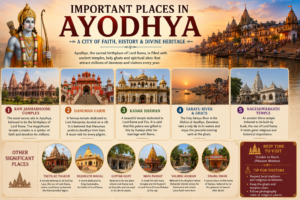
Ayodhya’s Future Growth
Ayodhya is undergoing a significant transformation fueled by religious tourism. It is witnessing a rapid rise in the development of roads, hotels, and transport networks to meet the surging demand of pilgrims and tourists.
The growth of the region has created numerous business opportunities for hoteliers, restaurants, shops, guides, and transporters.
At the same time, the city needs to balance its development with the preservation of its ancient temples and ghats, as well as the rich culture and traditions that it embodies.
Reasons Why Ayodhya Is Significant
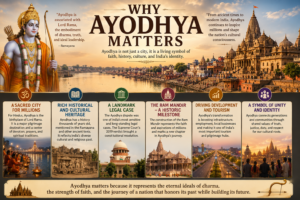
Ayodhya is significant for several important reasons. It is considered holy by millions of Hindus, as the birthplace of Lord Rama. It is of interest to historians and archaeologists because of the religious and cultural significance to people of different faiths. For lawyers and judges, it is a symbol of how the Indian judiciary handled a highly contentious dispute involving property claims, Hinduism, and the Indian constitution.
The city holds significance far beyond its home state of Uttar Pradesh. It is a place of faith, history, law, culture, tourism, and the evolving character of modern India.
Conclusion
Ayodhya is a city in India where ancient tradition meets modernity. A temple to Lord Rama gives Ayodhya its religious significance. However, its historical legacy has made it a highly controversial place in recent years.
The dispute over the Ram Janmabhoomi and the Supreme Court’s ruling on it in 2019 have had a major impact on the city’s future. Currently, the construction of the Ram Mandir and modern infrastructure develops Ayodhya into a significant religious and tourist destination.
Therefore, the objective understanding of this situation requires a balanced consideration of both religious feelings and historical criticism of the past, as well as an overview of the current state of affairs.
